
The useful idea
A useful record identifies the pigs, period, units and decision. Consistency matters more than expensive software.
The starting point
A modern pig farm handles animals, feed, purchases, staff time and sales every day. Separate records make it difficult to explain why a batch performed well or whether a cheaper ingredient saved money. A short shared record can connect the information.
Use current Ghanaian cedi prices and the farm’s delivered costs. Foreign budgets, old trial costs and feed-conversion figures from another herd are reference points at most. Build a baseline from the actual unit instead of treating an online number as a profit forecast.
Give each group a beginning and an end
Identify the batch, entry date, starting count and starting weight where measured. Record additions, transfers, deaths, removals and sales as they happen. Reconcile animal numbers before calculating performance so an unrecorded movement is not mistaken for a production result.
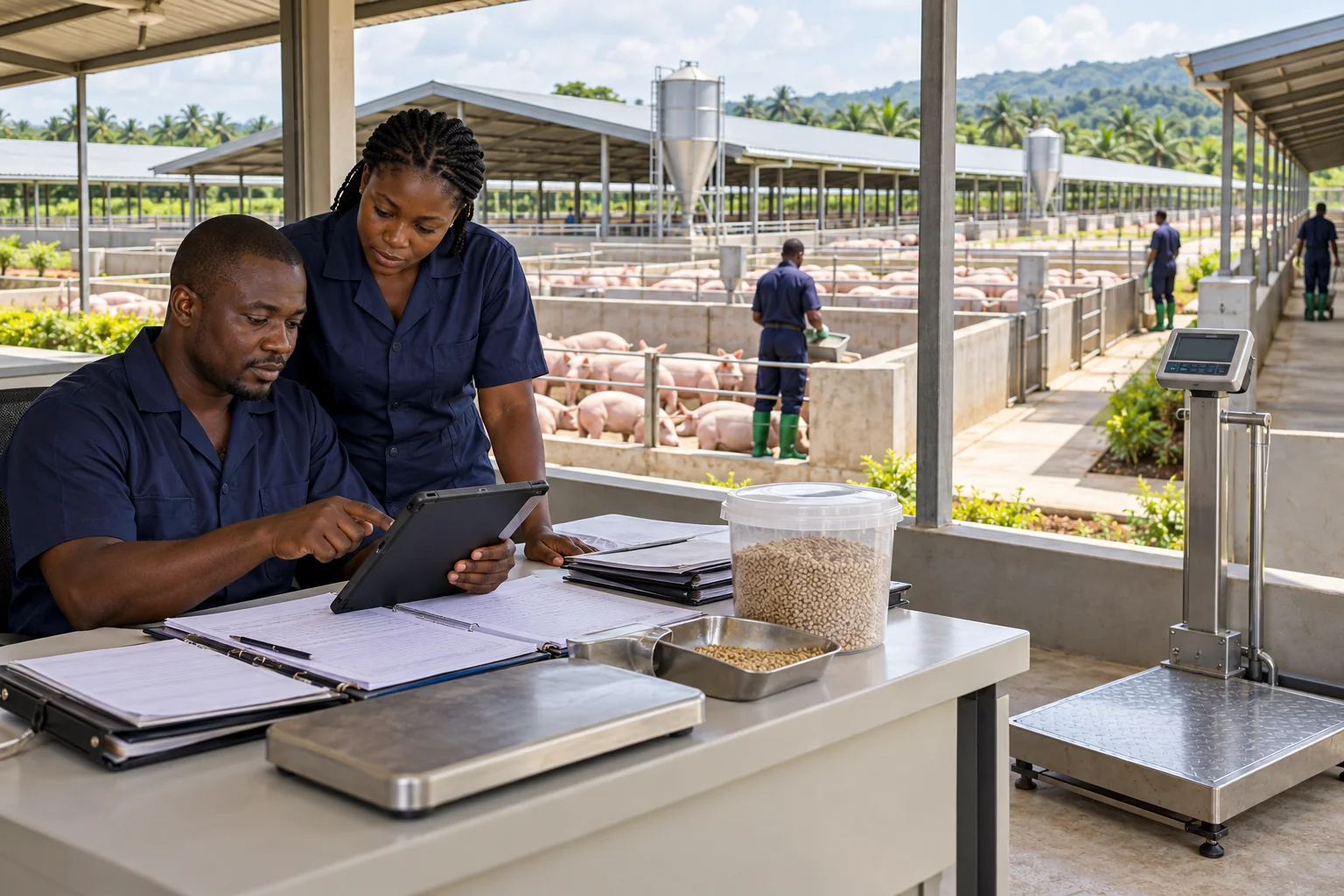
Use consistent units and maintained weighing equipment. Label estimated weights as estimates. Assign daily entries and a weekly check to named staff: an app cannot correct unidentified pigs or figures nobody records.
Connect feed issued with weight gained
Record feed delivered by date and batch, separating issues, returns and wastage. Link ration changes to those dates. Where measurements support it, feed conversion is kilograms of feed used divided by kilograms of liveweight gained over the same period.
For illustrative arithmetic, 1,000 kg of feed divided by 250 kg of recorded gain equals 4 kg feed per kg gain. This is not a Ghanaian performance target. Agree how transfers, deaths, retained feed and changing group sizes enter the calculation before comparing batches.
Put costs on a common basis
Track feed, haulage, processing, testing, veterinary work, labour, water and energy. Identify investment and finance costs separately so a feed-only margin is not called total profit. Record whether sales are per pig, liveweight or another agreed basis.
For cassava or BSF evaluations, include moisture, rejected material, processing losses and staff time. Compare the complete ration and resulting output. A low ingredient invoice can coexist with a higher cost per kilogram of saleable gain.
Turn the weekly review into action
Choose a few measures the team can influence: water faults, feed variation, deaths, growth, delayed sales and outstanding repairs. Investigate unexpected results without treating one number as a diagnosis. Link health concerns to veterinary observations rather than changing medicines from a spreadsheet.
Ghanaian technical training can help establish workable routines. FAO business-school methods provide a wider framework, while budgets and production cycles remain local. A regional West African business should keep currencies, product units and country costs explicit before comparing farms.
Take it back to the team
Your practical checklist
- Identify groups, dates, counts and weighing methods.
- Record feed, movements and losses consistently.
- Use matching periods and units for ratios.
- Separate feed margin from whole-business profit.
- Review a few measures and assign actions.
Sources & further reading
Start with the Ghanaian evidence and services below. The location and application notes explain how regional and international references should be used.
Ghana · technical and enterprise support
GAEC–BNARI: pig management and agribusiness training (opens in a new tab)A route to training in pig management, nutrition and records. Confirm current services directly; no partnership or endorsement is implied.
Ghana · on-farm research
CSIR: pig-feed packages using agro-industrial byproducts (2007) (opens in a new tab)Older trials across Ghanaian regions support evaluating byproducts. Historical costs and experimental diets are not current commercial specifications.
International · management teaching framework
FAO: Farm Business School handbook (opens in a new tab)Adapt methods to Ghanaian cedi costs, pig-production cycles and local markets. Example budgets are not local quotations.