The useful idea
Cassava can contribute energy to a balanced pig diet, but identify the product, process it safely and value it on a dry-matter basis.
The starting point
Cassava connects Ghana’s food-processing economy with opportunities in livestock feeding. Peels, pulp and root products may become useful ingredients instead of unmanaged residues. Their value depends on quality, processing capacity and the rest of the ration; low purchase cost alone is not enough.
Roots, peels, pulp and leaves are not interchangeable. They differ in fibre, moisture, nutrients and cyanogenic compounds. This guide is a decision framework for a Ghanaian pig unit or feed business, not a ready-to-mix formula or permission to feed untreated material.
Define the product and its supply route
Visit the processor and establish exactly what is available. Record the product, processing date, contamination risks, moisture and seasonal volume. Keep soil, plastic, chemicals and spoiled material out of feed production. Agree collection frequency before making a large feed commitment.
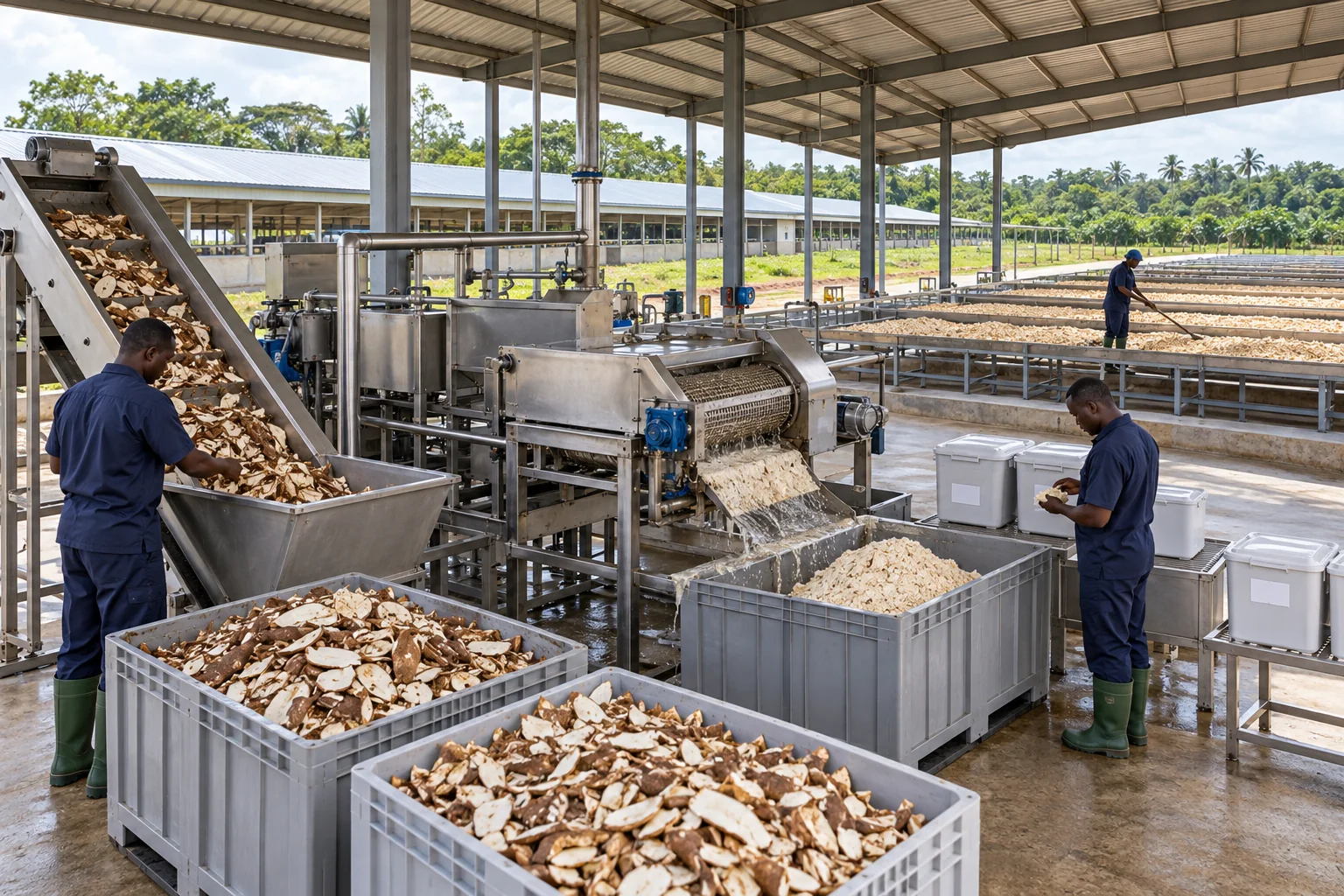
Plan reception, processing, drying or preservation and protected storage together. A regular supply of wet byproduct is useful only if the receiving system can handle it. Include rainy-season disruption, transport delays and competition with other uses in the supply estimate.
Control cyanogenic hazards with a validated process
Cassava can release hydrogen cyanide from naturally occurring compounds. Do not assume safety because a variety is described as sweet, because material looks dry or because pigs ate a previous load without obvious illness. Spoilage and contamination create additional risks.
Work with a trained processor, feed adviser and suitable laboratory to establish processing and release checks for the actual material. ILRI’s High-Quality Cassava Peel manual describes a technology developed in Nigeria: adapt it through training and verification. A number of sunny days copied from a guide does not prove a Ghanaian wet-season batch meets the specification. Keep processing wastewater away from clean water and livestock access.
Balance the diet rather than replacing bags one for one
Cassava root and peel products can supply energy but are not complete balanced feeds. Protein, fibre and moisture characteristics affect what else the ration needs. A nutritionist should set the inclusion and balance amino acids, minerals and other nutrients for the production stage.
A Ghanaian CSIR experiment assessed ensiled pulp and dried leaves in growers. It was preliminary, involving a small group over a short period. Its ingredient levels and old cedi costs are not blanket recommendations for piglets, breeding sows or another processor’s peels. Compare fresh and dried products on the same moisture basis.
Pilot performance and economics before expanding
Agree a professionally supervised evaluation with defined batches, suitable pigs, a comparison diet and clear stopping criteria. Record feed delivered, wastage, weights, health observations and processing losses. Avoid introducing a new cassava ingredient alongside several other major ration changes.
For a practical cost comparison, divide processing and delivery costs by kilograms of accepted dry material, then compare the complete formulated feed and cost of liveweight gain. Include labour, equipment, energy, testing and rejected batches. Ghana and neighbouring cassava-producing countries offer opportunities, but savings must be demonstrated in the farm’s own records.
Take it back to the team
Your practical checklist
- Identify the cassava product and processor.
- Validate processing and safety checks before feeding.
- Use laboratory information and a pig nutritionist.
- Plan rain protection, preservation and wastewater handling.
- Compare complete-feed cost and measured performance.
Sources & further reading
Start with the Ghanaian evidence and services below. The location and application notes explain how regional and international references should be used.
Ghana · preliminary feeding trial
CSIR: grower pigs fed cassava pulp and dried leaves (2012) (opens in a new tab)A five-week study involving 24 growers. Its inclusion levels and historical prices are not recommendations for every cassava product, piglet or sow.
West Africa · processing technology developed in Nigeria
ILRI Manual 35: High-Quality Cassava Peel mash (2019) (opens in a new tab)A regional processing reference. Ghanaian users still need training, quality verification and arrangements suited to local equipment and wet-season drying.
International · technical background
FAO: roots and tubers in animal feeding — cassava (opens in a new tab)Explains nutritional and cyanogenic hazards. It does not establish a Ghanaian legal limit or certify a processor’s product.