The useful idea
Sound storage protects suitable grain; it does not repair contamination that arrived with the crop.
The starting point
Maize stored for a Ghanaian pig-feed business must keep its quality between purchase and mixing. Drying delays, moisture, insects and damaged packaging can undermine a purchase that looked economical. Plan receiving and storage capacity before the first truck arrives.
Cowpea and maize have different handling and end-use requirements. A crop intended for sale, seed or a formulated pig ration needs the relevant specification. Ghanaian maize research is useful local evidence, but its results should not be presented as a cowpea or complete-feed storage protocol.
Prepare the drying and receiving route
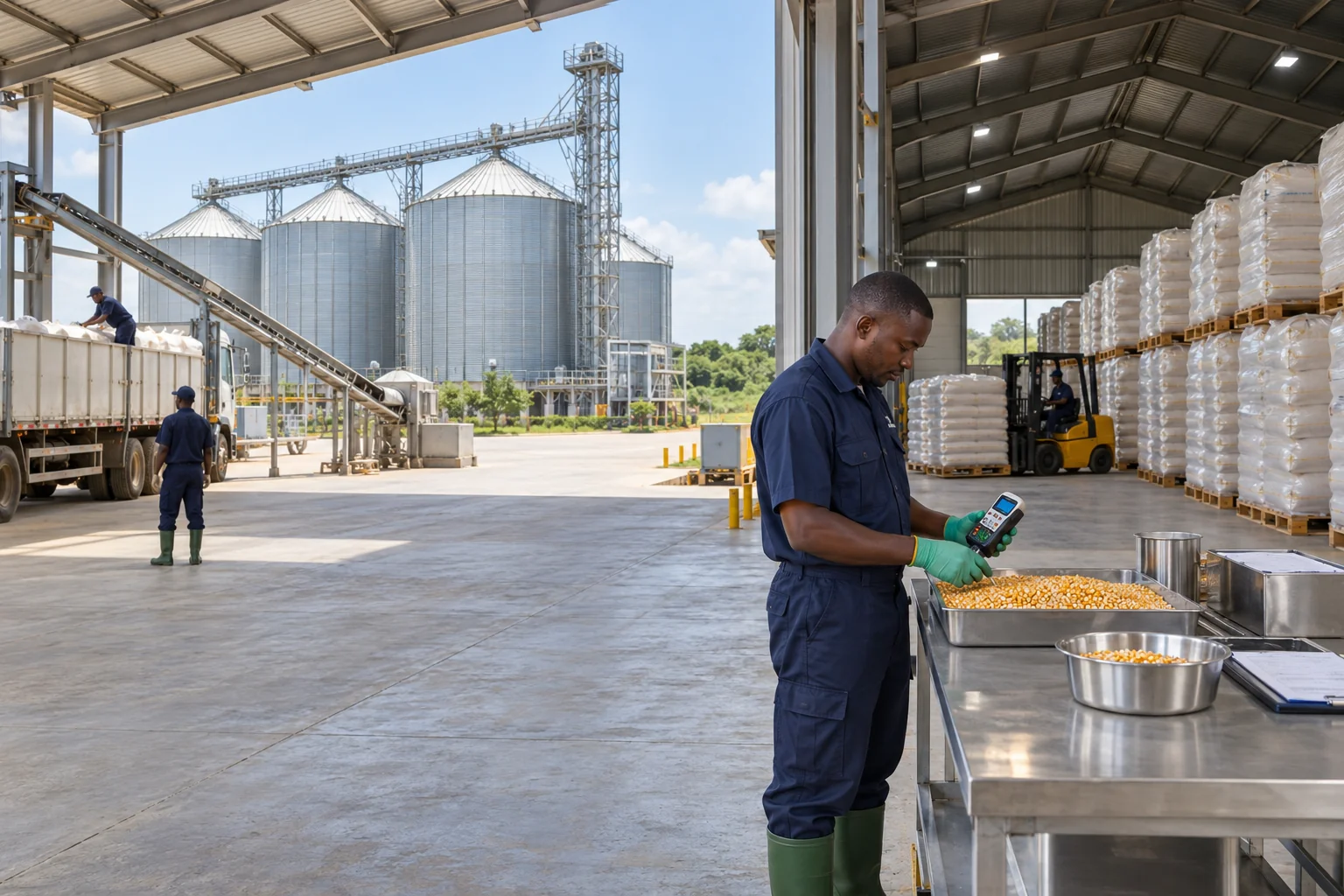
Agree where grain is inspected, sampled and held while awaiting acceptance. Make room for wet-weather delays and keep lots separate. Use appropriate moisture measurement and a sampling procedure suited to the crop and planned storage period.
Avoid relying on appearance or a bite test. Record the actual result and equipment used. A rejected or unassessed load should not be tipped into accepted stock simply to release the truck.
Choose storage for the withdrawal pattern
Select bulk or bag arrangements that fit the volume and how feed is drawn off. Where hermetic storage is suitable, follow the actual product instructions for dry grain, liner condition, sealing and resealing. Limit damage from handling, rodents and unsuitable surfaces.
Ghanaian work in Wa and Ejisu examined maize packaging alongside a preharvest biological-control treatment. That does not mean any sealed bag eliminates aflatoxin or that wet or contaminated grain becomes acceptable after sealing.
Keep the building inspectable
Maintain roofs, unloading surfaces, pallets where used and accessible inspection routes. Record leaks, pests, damaged packages and repairs. Keep the store apart from manure handling and chemical contamination.
Check conditions after rain as well as during routine rounds. Retain source, sampling and movement records for each batch. The building, package and operating routine are one system; good bags cannot compensate for wet grain or a leaking roof.
Treat feed safety as a release decision
Ghanaian studies document aflatoxin concerns in maize. Use risk-based laboratory assessment and qualified interpretation. Do not send unsuitable food grain to pigs on the assumption that animals can tolerate any rejected material, or mix a suspect batch into better grain.
Review quality at withdrawal, losses and the costs of extra drying or rehandling. For regional purchases, check origin, transport and the applicable Ghanaian requirements. Overseas toxin limits quoted in a paper are not automatically the current local feed standard.
Take it back to the team
Your practical checklist
- Specify the crop, use and storage period.
- Prepare protected receiving and drying capacity.
- Measure moisture and retain batch records.
- Follow the chosen storage system’s instructions.
- Assess suspect grain before feed use.
Sources & further reading
Start with the Ghanaian evidence and services below. The location and application notes explain how regional and international references should be used.
Ghana · maize-safety research
Dadzie and colleagues: stored maize and aflatoxin in Ghana (2019) (opens in a new tab)Supports local attention to contamination. Overseas limits discussed in the paper must not be read as current Ghanaian feed standards.
Ghana · experiments in Wa and Ejisu
Kaburi and colleagues: Aflasafe GH02 and storage packaging (2025) (opens in a new tab)Local maize evidence. It does not mean a bag detoxifies contaminated grain or that results transfer unchanged to cowpea or mixed pig feed.
International · grain-safety principles
FAO: preventing mycotoxins in stored grain (opens in a new tab)Apply prevention and sampling principles with local laboratory advice. Foreign limits and crop moisture targets are not automatically Ghanaian feed specifications.