The useful idea
Build a safe, consistent ingredient business first: producing larvae does not automatically produce a suitable pig ration.
The starting point
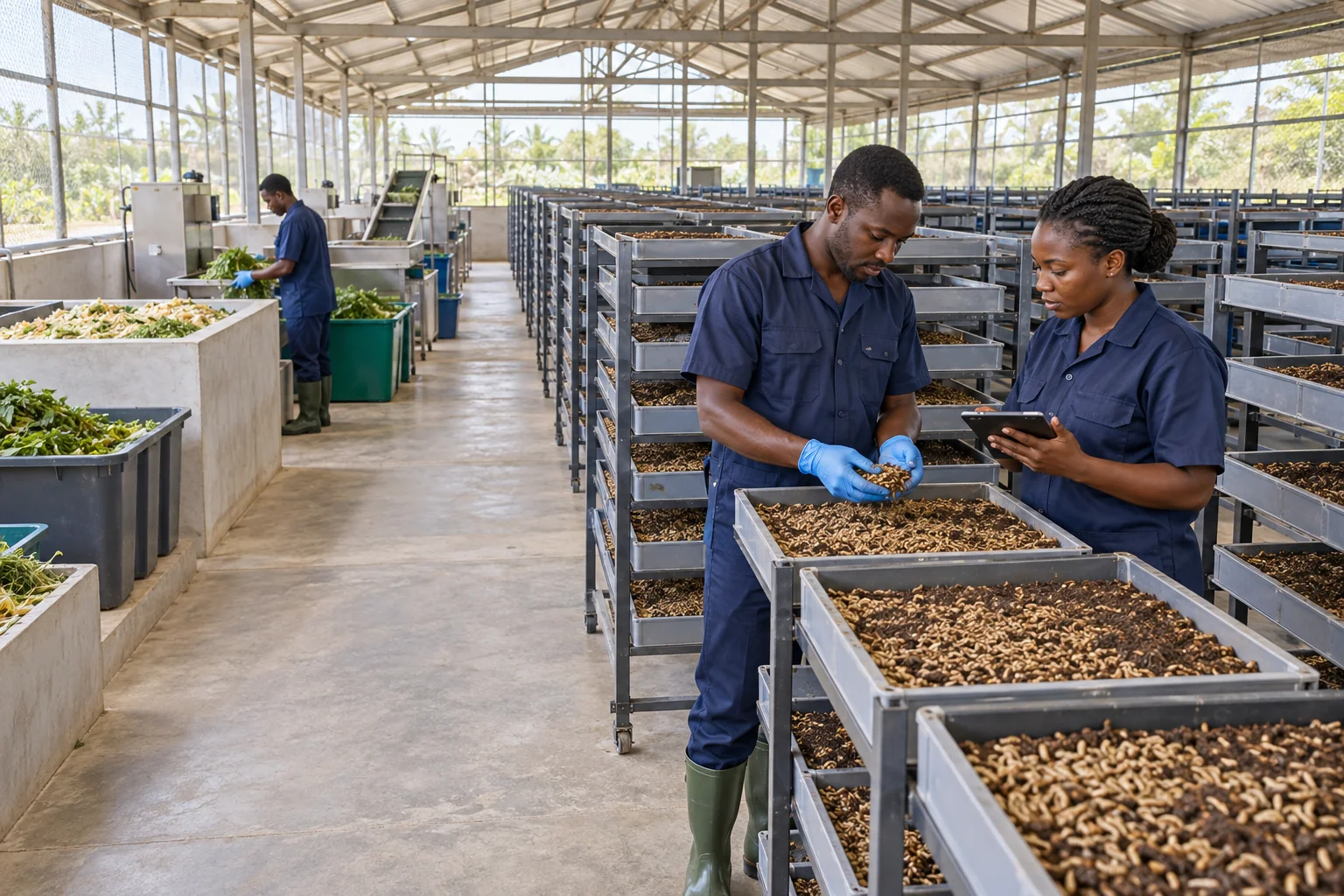
Black soldier fly larvae can turn selected organic materials into biomass that may be processed into a protein-and-fat feed ingredient. Ghanaian research and programmes are exploring this opportunity. A commercial pig business needs to assess consistent supply, feed safety, nutrient value and the total cost of producing an accepted ingredient.
There are two enterprises to evaluate: rearing insects and feeding pigs. A successful colony does not prove that its growing material is acceptable for the feed chain or that meal can replace fishmeal or soybean meal kilogram for kilogram. This guide does not claim that Royal Baobab Farms operates a BSF facility.
Get Ghanaian training and define the product
Seek practical instruction from competent Ghanaian researchers or technical providers. GAEC–BNARI’s policy work and University of Ghana colony research offer local starting points. Decide whether the output is fresh larvae, dried whole larvae, full-fat meal or defatted meal: each has different handling and formulation requirements.
Confirm current Ghanaian requirements with the relevant feed, standards and veterinary authorities before commercial production or sale. A programme announcement or policy recommendation is not a product approval. Verify what any supplier’s claimed certification actually covers.
Control substrates and separate dirty and clean work
A substrate is the material on which larvae grow. For an initial feed project, seek advice on traceable, suitable plant-processing byproducts instead of treating mixed municipal waste or pig manure as free feedstock. Exclude hazardous material and keep source records. Research showing that larvae grow on a material does not establish feed safety.
Separate reception, rearing, harvesting and processing so rejected waste cannot contaminate finished meal. Provide suitable hygiene, drainage, pest control and worker protection. Keep insect production outside the pig unit’s clean routes. Do not cycle pig manure or pork-containing waste back into pig feed without a specifically validated and authorised system.
Release a consistent, tested ingredient
Record substrate, dates, yields, processing conditions, water and energy use, and storage for every batch. Establish appropriate microbial, contaminant and nutrient checks with competent technical support. Heat treatment, drying and milling need validated operating conditions; appearance alone is not a release test.
Full-fat and defatted products differ, and changing substrates can alter composition. Obtain the analysis needed for protein quality, fat, minerals and other formulation requirements. Leftover rearing material, often called frass, also needs assessment and appropriate treatment before agricultural use. It is not automatically a safe, standardised fertiliser.
Test the ration and the business case separately
Overseas pig trials help frame the opportunity. A Canadian nursery-pig experiment tested a particular ingredient in balanced diets; it does not establish the same outcome from a Ghanaian substrate, home-dried product or different herd. Do not copy an inclusion percentage without a qualified pig nutritionist.
Use a defined quality specification and supervised feeding evaluation. Record growth, feed use, health and complete-ration cost. Include insect breeding, buildings, labour, rejected substrates, drying, laboratory work and waste handling. For regional sales, check requirements in each destination country. Scale when dependable safe output, demand and measured economics agree.
Take it back to the team
Your practical checklist
- Obtain Ghanaian training and check applicable requirements.
- Define the product and substrate controls.
- Separate waste reception, finished feed and pig areas.
- Validate processing and test meal quality.
- Evaluate balanced pig diets and costs before scaling.
Sources & further reading
Start with the Ghanaian evidence and services below. The location and application notes explain how regional and international references should be used.
Ghana · research and policy recommendations
GAEC–BNARI: black soldier fly policy brief (2023) (opens in a new tab)Describes opportunities and development needs. A policy brief is not a product approval, and larval growth does not prove that a substrate is feed-safe.
Ghana · insect-production research
University of Ghana: culturing black soldier fly colonies (2019) (opens in a new tab)Local colony research, not a pig-feeding trial or proof that waste-grown larvae are safe to feed.
Ghana · programme and production context
IITA: Ghana’s black soldier fly programme (opens in a new tab)Documents local BSF development. Programme activity does not validate an individual meal, supplier, inclusion rate or savings claim.
Canada · controlled feeding experiment
Crosbie and colleagues: BSF meal in nursery-pig diets (2021) (opens in a new tab)A particular processed ingredient in balanced diets. Results cannot be assumed for Ghanaian substrates, batches, herds or production costs.